1. Summary
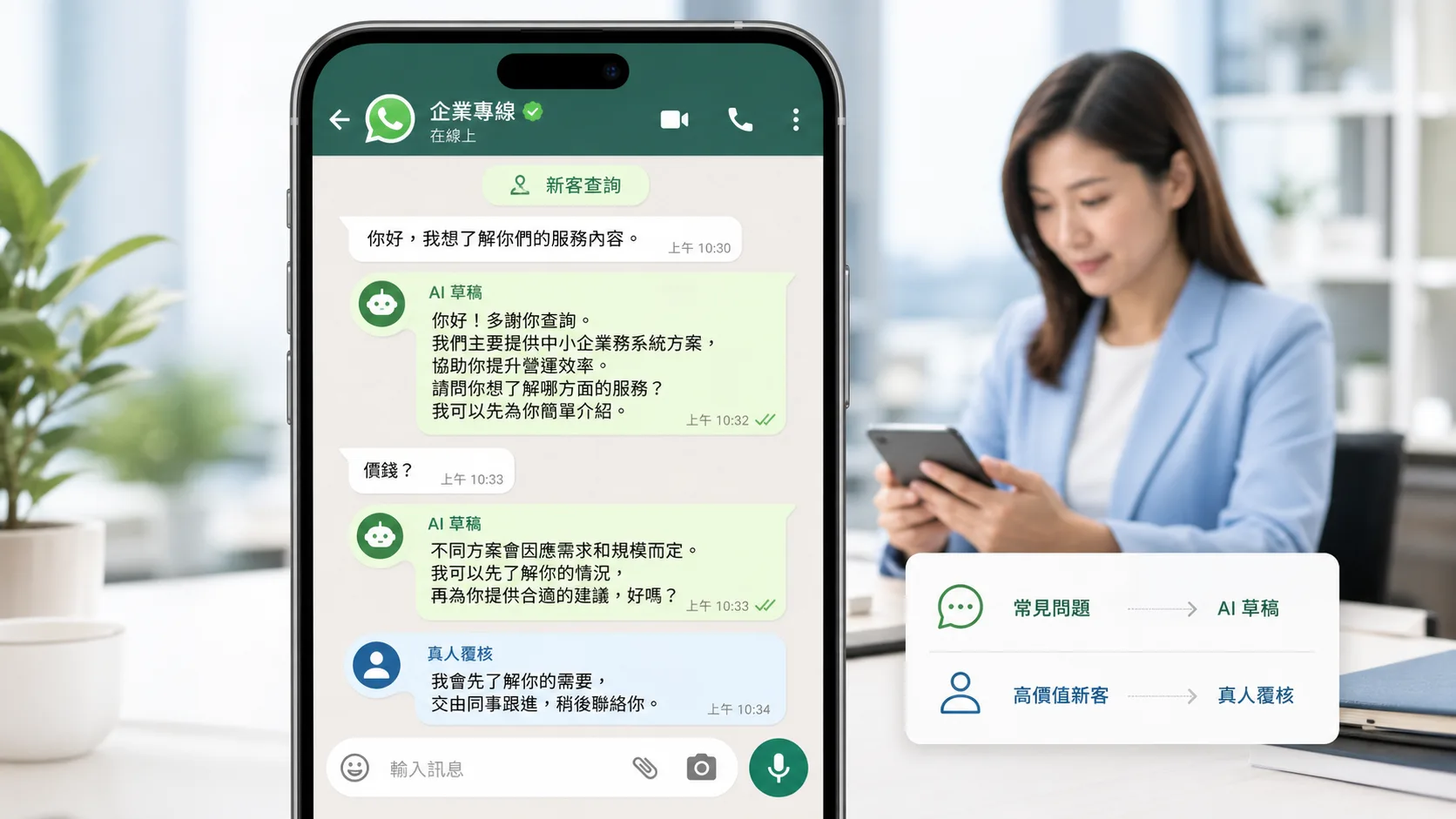
Hong Kong SMEs can use a WhatsApp AI chatbot, but they should not blindly use AI to replace human reception for new customer enquiries. For new leads, the safer order is: human response first, AI-assisted response second, and no response last. AI is most useful for non-office hours, overflow enquiries, basic questions, information collection, and initial triage. Complaints, transactions, pricing, discounts, formal commitments, sensitive data, and high-value leads should be handed back to a human.
The real design challenge is not just building a chatbot that replies instantly. It is building a WhatsApp enquiry flow with handoff rules, risk levels, conversation records, and human accountability. When a new customer messages your company for the first time, they are not only asking for an answer. They are also judging whether the company is reliable and whether it takes them seriously.
2. Direct Answer
Hong Kong SMEs should treat a WhatsApp AI chatbot as a tool for catching and triaging enquiries, not as a direct replacement for human reception.
If a human can reply quickly and well, new customer enquiries should usually be handled by a human first. This is especially true for service businesses, professional services, education centres, consultants, B2B solution providers, high-ticket retail, and any business where trust matters. The first conversation is often valuable sales time. It is not only about answering "Do you have availability?", "How much does it cost?", or "When can you start?" It is also about understanding the customer's needs, budget, timeline, decision process, and concerns.
In reality, however, not every company can reply instantly all the time. At night, on holidays, during lunch, in busy periods, or when staff are already handling several customers, leaving a new enquiry unanswered can also create loss. In those cases, AI can catch the conversation first, answer basic questions, collect information, classify the enquiry, and remind a human to follow up.
A more accurate rule is:
| Situation | Better approach |
| A human can reply quickly and well | Human first |
| Non-office hours or staff cannot reply fast enough | AI catches the enquiry, then hands over to a human |
| The customer only asks for basic information or FAQs | AI can reply or help organize the information |
| Complaints, refunds, transactions, pricing, discounts, or formal commitments are involved | Hand over to a human |
| High-value lead or complex sales opportunity | Human first, with AI preparing the background |
3. Separate Service Quality From Operating Flow
Many companies discuss WhatsApp AI chatbots by asking: "Can AI replace a person when replying to customers?"
That jumps too quickly to the tool layer. A better question is: for this type of customer conversation, who should handle it from a service-quality perspective? And operationally, if no human is available at that moment, how should AI support the gap?
From a service-quality perspective, human response is usually best. A human can read tone, judge emotion, handle exceptions, adjust the wording, and ask the right follow-up question. This matters especially in a first enquiry, where the customer is not only asking for an answer but also observing how the company receives them.
From an operating-flow perspective, AI can help catch the gaps. Many enquiries arrive outside office hours, or while staff are in meetings, on-site, serving customers, following up orders, or preparing quotations. If nobody replies, the customer may simply ask another company. The value of AI is not to take over every conversation. It is to catch the enquiry when a human cannot appear immediately, keep the customer's information, classify the risk, and prepare the handoff.
So the core principle is not simply "AI first" or "human first". It is:
If a human can reply, human first. If a human cannot reply, AI catching the enquiry is better than no response. If the conversation becomes high-risk or high-value, hand it back to a human.
4. A New Customer Enquiry Is Also a Test of Reception
Many WhatsApp enquiries look simple on the surface:
- What time do you close?
- How much is this service?
- Can I book tomorrow?
- Is this product in stock?
- I want to learn more about your solution. What should I do?
But for a new customer, these questions often carry another meaning. Does the company reply quickly? Is the explanation clear? Does it feel responsible? Is it trying to understand me, or just trying to get rid of me quickly?
If the customer's first contact with the company feels like being pushed into a fully automated process, with no human willingness to understand their situation, trust can fall. This is not only a question of whether AI gives the correct answer. It is about how the customer feels about the company's reception.
For many Hong Kong SMEs, new enquiries are an important sales entry point. Enquiries from ads, social content, referrals, Google search, website forms, or WhatsApp buttons all have an acquisition cost behind them. If all of them are handed to a chatbot without proper handoff rules, the company may appear to save staff time while reducing the chance of conversion.
5. Why Human Service Remains a High-Value Reception Channel
In many industries, human reception is part of the service value itself.
A high-end restaurant usually does not begin by asking every customer to scan a QR code, place the order alone, and handle every question by themselves. This is not because QR ordering is useless. It is because, in some contexts, human reception is part of the experience. Customers need to feel understood, welcomed, and taken seriously.
The same logic applies to WhatsApp. AI can improve efficiency, but it does not mean every new customer should go through AI first. If the lead value is high, the decision is complex, trust matters, or the customer needs a tailored discussion, human reception still carries strong value.
AI can prepare the human response. It can organize customer information, tag the enquiry type, remind staff to follow up, and draft a reply. Those are valuable uses. But if the first conversation with a new customer is turned into the lowest-cost automatic reply, the company may be using AI in the wrong place.
6. What Is a WhatsApp AI Chatbot Good At?
A WhatsApp AI chatbot is not useless. If designed well, it can be very practical for Hong Kong SMEs.
AI is most suitable for:
- basic replies outside office hours;
- catching enquiries when staff cannot reply fast enough;
- answering common questions such as opening hours, address, service scope, and booking method;
- collecting customer name, phone number, company, needs, budget, and timeline;
- classifying whether the enquiry is sales, after-sales, complaint, partnership, recruitment, or another type;
- telling the customer that a human teammate will follow up during office hours;
- summarizing the conversation and creating follow-up tasks for the internal team.
These tasks share one common feature: they are about reception, organization, classification, and preparation. They are not about making high-risk business decisions on behalf of the company.
For example, if an education centre receives a parent enquiry at night, AI can answer basic course information, collect the student's grade and subject needs, then create a follow-up task for the next day. That is better than no reply, and it does not require AI to promise tuition discounts, makeup class arrangements, or seat availability.
For a B2B service company, AI can first ask what type of company the prospect runs, what workflow they want to improve, what systems they currently use, and when they hope to start. The sales or consulting team can then follow up with context, instead of starting from zero.
7. When Should the Conversation Return to a Human?
The most important design question for a WhatsApp AI chatbot is not how many questions it can answer. It is whether it knows when to stop.
The following situations should not be handled by AI from start to finish.
7.1 Complaints and Negative Emotion
If the customer is complaining, angry, dissatisfied, or asking who is responsible, a standardized AI reply can make the situation worse. Complaint handling requires empathy, responsibility judgment, internal coordination, and a remedy plan. It should not rely only on a chatbot.
AI can still help by flagging the conversation as high risk, notifying the responsible person, and summarizing the dialogue so the customer does not need to repeat everything. But the actual response should come from a human.
7.2 Transactions, Pricing, Discounts, and Formal Commitments
Prices, discounts, payment, refunds, contracts, delivery dates, and service commitments are high-risk topics. If AI replies using outdated information, misunderstanding, or an unupdated policy, the company may take on unnecessary responsibility.
A safer approach is to let AI draft or collect information, while formal commitments are confirmed by a human. When money, deadlines, exceptions, or contractual wording are involved, the system should require human approval.
7.3 Sensitive Data and Privacy Risk
If the conversation involves identity information, medical details, financial information, legal matters, student data, customer contracts, payment records, or other sensitive content, the company must design in advance what AI can access, what it can record, and who can see the information.
An article should not describe AI chatbots as tools that can freely read and process all company data. For SMEs, clear permissions, data retention, and activity records are more important than simply replying fast.
7.4 High-Value Leads and Complex Sales Opportunities
If the customer shows strong buying intent, asks for a quotation, wants to book a meeting, describes a large project, or provides detailed requirements, the conversation should not remain at the AI reply layer.
AI can organize the background and prepare the human follow-up. But building trust, understanding needs, judging budget, and moving the sale forward still requires people.
7.5 AI Does Not Understand, or the Customer Asks for a Human
If the customer asks several times and AI still answers the wrong thing, or if the customer clearly asks for a person, the system should hand over immediately. Repeating apologies or irrelevant answers will only use up the customer's patience.
8. Why AI Should Not Pretend to Be Human
Some companies want AI replies to sound as human as possible, and may even prefer not to tell the customer that the response is generated by AI. This needs care.
For new customer enquiries, trust is the priority. If the customer later discovers that they have been speaking to AI without the company making it clear, trust can be damaged. Even if AI sounds natural, that does not mean it should pretend to be human.
A safer approach is to clearly indicate that it is an automated assistant or AI assistant, while providing a path to human handoff. For example: "I will help record your details first, and a teammate will follow up." This does not need to sound stiff, but it should be honest.
Transparency does not reduce the experience. It reduces misunderstanding. Customers can accept AI helping to catch an enquiry, but they usually do not like being misled by a system pretending to be a person.
9. A Safer WhatsApp Enquiry Design
The safest design is not "AI first for everything", nor is it "a human must instantly handle everything". It is risk-based and value-based triage.
One possible design is:
| Enquiry type | What AI can do | When to hand over |
| Basic information | Answer opening hours, address, and service scope | Customer asks for details or is dissatisfied |
| Booking enquiry | Collect date, time, and needs | Confirming availability, changes, or special arrangements |
| Quotation enquiry | Collect requirements, budget, and quantity | Any formal quotation, discount, or commitment |
| Complaint | Collect information and flag urgency | Immediately |
| High-value lead | Organize background and notify staff | Priority human follow-up |
| Non-office-hour enquiry | Catch the enquiry and state follow-up timing | During office hours |
The key is to make AI part of the workflow, not the whole workflow.
AI handles reception, organization, classification, and reminders. People handle judgment, commitments, relationship, and accountability. The system stores the data, limits permissions, records actions, and manages follow-up.
10. How Hong Kong SMEs Can Start
Before introducing a WhatsApp AI chatbot, a company does not need to make everything complex from day one. A practical first step is to organize existing enquiries.
First, list the 20 most common WhatsApp questions from the past month. Do not start by asking how AI should answer them. Start by classifying the questions: basic information, booking, quotation, after-sales, complaint, partnership, recruitment, payment, refund, or something else.
Second, classify the risk level. Which questions can AI answer directly? Which questions can AI only collect information for? Which questions must immediately go to a human?
Third, write the handoff rules clearly. For example:
- if the customer mentions complaint, refund, or negative review, hand over to a human immediately;
- if the customer asks for a quotation, discount, or payment arrangement, send it to a human for confirmation;
- if the customer asks basic information, AI can reply first;
- if AI cannot understand the customer after two attempts, hand over to a human;
- outside office hours, AI catches the enquiry and creates a follow-up task for the next working period.
Fourth, design the conversation records and follow-up tasks. An AI reply does not mean the work is finished. The system should know whether the enquiry has been followed up, who owns it, what the next step is, and whether the customer is still waiting.
If these foundations are not clear, faster AI replies may simply make the confusion faster.
11. The oneflash View
oneflash does not treat a WhatsApp AI chatbot as an isolated auto-reply tool. For Hong Kong SMEs, the more important question is how WhatsApp enquiries fit into a controlled operating system.
A more mature design should include:
- WhatsApp enquiry classification;
- customer data and CRM records;
- follow-up tasks;
- quotation, order, inventory, or ERP-related information;
- what AI may read and draft;
- which actions need human confirmation;
- conversation records and action records;
- human handoff rules for high-risk conversations.
This is how AI becomes part of the company's enquiry workflow, rather than just a tool that chats. People handle judgment and relationship. AI catches, organizes, and reminds. The system handles data, permissions, and records.
If a company is not sure whether to start with WhatsApp auto-reply, a human handoff flow, or CRM / ERP follow-up tasks, the first step is usually not buying a tool. It is mapping the current new-customer enquiry flow and separating which questions AI can catch from which questions must be handled by a person.
12. Call to Action
If you are not sure whether your company should start with WhatsApp auto-reply, human handoff rules, or CRM / ERP follow-up tasks, start with one new-customer enquiry flow. Map the common questions, risk levels, handoff rules, and follow-up ownership first. Then decide where AI should be added.