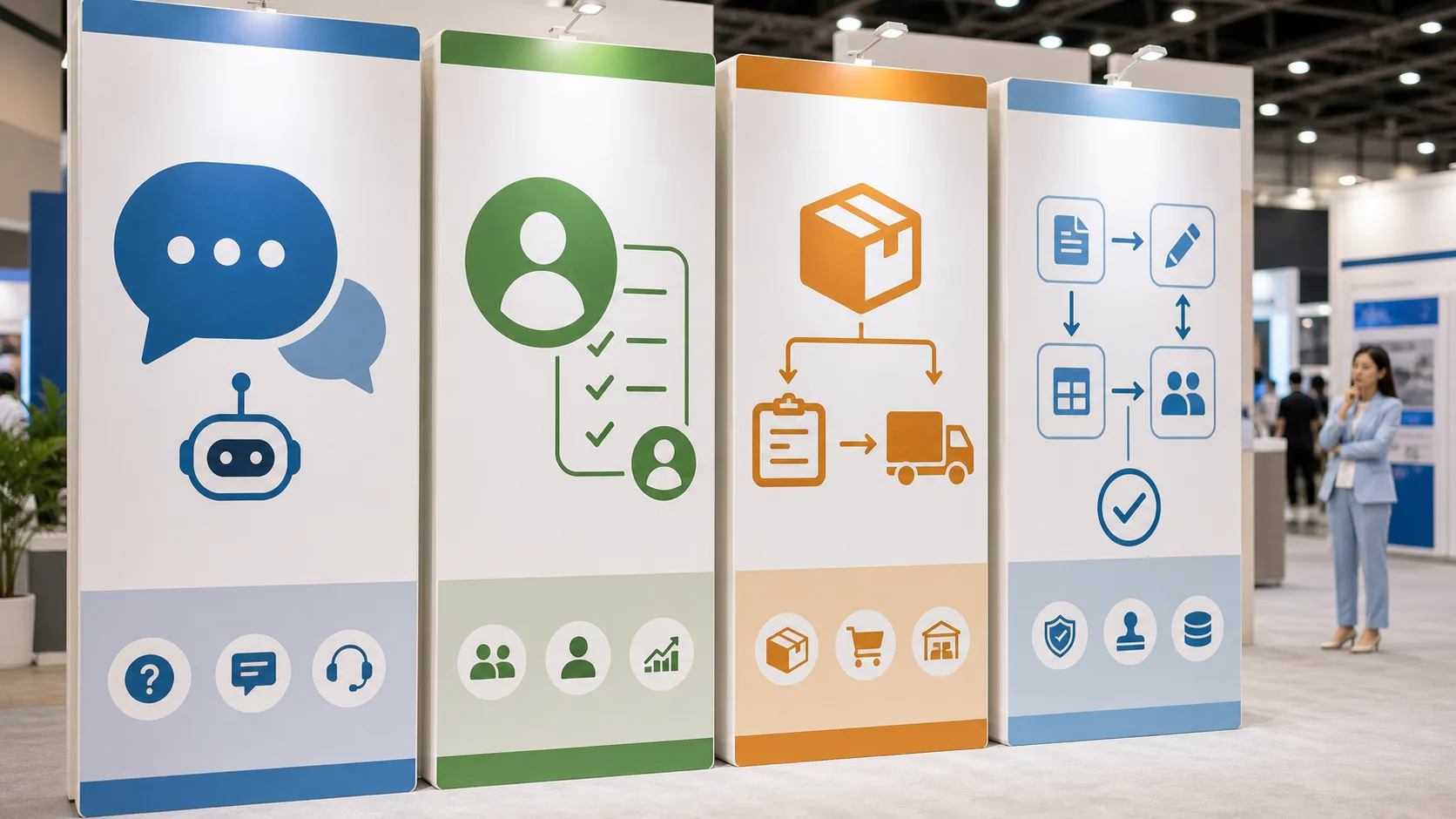
Most Hong Kong SMEs do not have an AI problem. They have a sequencing problem. The team wants "AI automation", but no one is clear whether the first move should be a chatbot, a CRM cleanup, an ERP workflow project, or an AI agent layer. If you buy the wrong category first, you usually end up with a smarter front end on top of a messy process.
The fastest way to choose is simple: start with the most broken workflow, not the most fashionable label. If the issue is repeated public enquiries, a chatbot may be enough. If follow-up is inconsistent and customer records are scattered, CRM usually comes first. If operations data is the bottleneck, ERP automation matters more. If staff already have systems but still waste hours preparing the next step, that is where AI agents start to make sense.
For oneflash, the goal is not uncontrolled end-to-end autonomy. The goal is a controlled AI-ready business system where AI can look up approved information, prepare drafts, summarise context and support staff decisions inside permission boundaries.
1. The plain-English version
| Option | Best first use | Works well when | Still missing on its own |
| Chatbot | FAQ handling and enquiry capture | Questions are repeated and low-risk | It rarely understands customer history, quotes, orders or approvals |
| CRM | Lead ownership and follow-up discipline | Sales and admin teams lose track of prospects | It does not automatically solve operations or cross-system workflow |
| ERP automation | Order, stock and internal process control | Your core pain is operational data and cross-department coordination | It is not usually the right front-door tool for enquiry and conversation |
| AI agent workflow | Drafting, lookup, summaries, routing and controlled next-step support | You already know which data the AI may read and which actions need approval | It requires defined permissions, process rules and a clean enough system base |
This is why "AI agent vs CRM" is often the wrong question. CRM and ERP are system layers. AI agents are assistant layers. Chatbots are conversation layers. The right choice depends on where your workflow breaks first.
2. When a chatbot is enough
A chatbot is a strong first step if your team mainly struggles with:
- repeated website or WhatsApp enquiries;
- slow first response to simple questions;
- basic triage before a human takes over;
- information capture that does not depend on complex customer or order history.
In that situation, the chatbot acts as the front desk. It collects contact details, classifies the request, answers approved FAQs and routes the case to the right person.
The problem starts when the conversation depends on context the bot cannot see. Questions like:
- "What happened to my last order?"
- "Did your team already quote us?"
- "Can this case go ahead without manager approval?"
- "Which staff member owns this account?"
Once the answer depends on real business data, the chatbot stops being the solution and becomes only the entry point.
3. When CRM should come before AI
If your team is losing leads, forgetting follow-up, or working from too many scattered inboxes, CRM usually matters before AI agents.
CRM brings basic order:
- one owner per lead;
- one visible follow-up status;
- one place for conversation history;
- one record of who promised what and when.
Without that discipline, AI has very little reliable context to work with. It can still generate polished text, but the text may be disconnected from the real customer state.
For many Hong Kong SMEs, a practical first workflow looks like this:
website form or WhatsApp enquiry -> CRM record -> AI summary or reply draft -> staff review
That sequence is much more useful than adding AI on top of inbox chaos. If your current pain is follow-up quality, start by fixing the customer data layer. The relevant oneflash entry point is its CRM software.
4. When ERP automation is the real issue
Some companies think they need AI because work feels slow. But the real blocker is often operational data:
- order status is unclear;
- stock data is unreliable;
- quotes and fulfilment are disconnected;
- departments update different spreadsheets or tools;
- front-line staff promise things that the back office has not confirmed.
That is not primarily a chatbot problem. It is an operations-system problem.
ERP automation helps standardise transactions, inventory, purchasing, delivery and internal workflow state. It solves "what is happening inside the business" before AI tries to improve "how quickly we respond around it".
If the operational layer is weak, AI can make responses faster but not safer. It may sound confident while reading inconsistent data. That is why many SMEs should stabilise ERP or workflow logic before expecting AI to improve execution quality. The related system layers are easier to picture through inventory management system and B2B ordering system examples.
5. When AI agents become worth it
AI agents make sense when the team already has systems, but staff still spend too much time on preparation work:
- checking several systems before replying;
- summarising long customer histories;
- preparing quotation drafts;
- identifying missing data;
- routing tasks to the right owner;
- turning raw records into a next action.
That is where an AI agent workflow adds leverage.
In a controlled business setup, the AI agent may:
- pull approved customer and workflow context;
- prepare a WhatsApp or email draft;
- suggest follow-up steps;
- summarise unresolved cases;
- create a waiting-for-approval task;
- flag exceptions for human review.
What it should not do by default is act without control. Sensitive actions such as editing important records, confirming prices, changing order status, or sending outbound messages at scale should still sit behind permissions, approval and audit trail.
6. Three quick Hong Kong SME examples
6.1 Service business
If new business mostly arrives through forms, WhatsApp and email, and the team keeps missing follow-up, the likely order is:
chatbot or form intake -> CRM -> AI summaries and draft replies -> human approval
The core issue is usually sales workflow clarity, not ERP first.
6.2 Trading or wholesale company
If customers ask about stock, delivery timing, quotations and previous orders, a chatbot alone will not fix the problem. The more realistic order is:
operations data cleanup -> ERP or workflow alignment -> CRM or customer context -> AI-assisted response preparation
The AI becomes useful only after the data layer is trustworthy enough.
6.3 Digitised team that is still too manual
Some SMEs already have CRM, forms and messaging tools, but staff still do a lot of invisible work:
- hunting for context;
- stitching together updates;
- rewriting similar replies;
- deciding where a case should go next.
That is the moment when AI agents stop being a buzzword and start becoming practical workflow assistants.
7. The buying mistake to avoid
The most expensive mistake is not choosing the "wrong brand". It is choosing the wrong layer.
Bad buying questions:
- Which AI chatbot is the smartest?
- Should we buy AI agent instead of CRM?
- Is ERP with AI branding automatically enough?
Better buying questions:
- Where does information break today?
- Which step takes the most manual preparation?
- Which actions need language understanding versus rule execution?
- What can AI draft, and what must a person approve?
- Are we missing a front-door tool, a customer data layer, an operations layer, or an assistant layer?
Once you ask those questions, the categories become easier to separate.
8. Where oneflash fits
oneflash.hk should be understood as the product website and source of truth for oneflash Agentic Business Suite. The positioning is not "just a chatbot" and not "just a traditional ERP". It is closer to an AI-ready business system for Hong Kong SMEs, connecting websites, WhatsApp workflow, CRM, operations data, workflow automation and human approval with controlled AI assistance.
That means oneflash is most relevant when your company already sees a system problem, not just a messaging problem. If the team is trapped in spreadsheets, inboxes, manual follow-up and disconnected process handoffs, the best first step is usually workflow diagnosis rather than shopping for the loudest AI label.
If you want the bigger category explanation first, the related oneflash guide is AI Agent Business System Hong Kong.
9. What to do next
Before buying anything, map one broken workflow:
- Where does the enquiry enter?
- Where is the customer or order data stored?
- Who owns the next action?
- Which step is slowest?
- Which action needs approval?
That one exercise usually tells you whether the company needs a chatbot, CRM cleanup, ERP workflow improvement, or an AI agent layer first.