Amazon founder Jeff Bezos once framed a useful question for business owners: many people ask what will change in the next five to ten years, but an even more important question may be what will not change.
In Amazon's context, customers are likely to keep wanting better prices, faster delivery, and more choice. Technology, platforms, and competitors will change, but if some customer needs remain relatively stable, a company can invest around those stable needs.
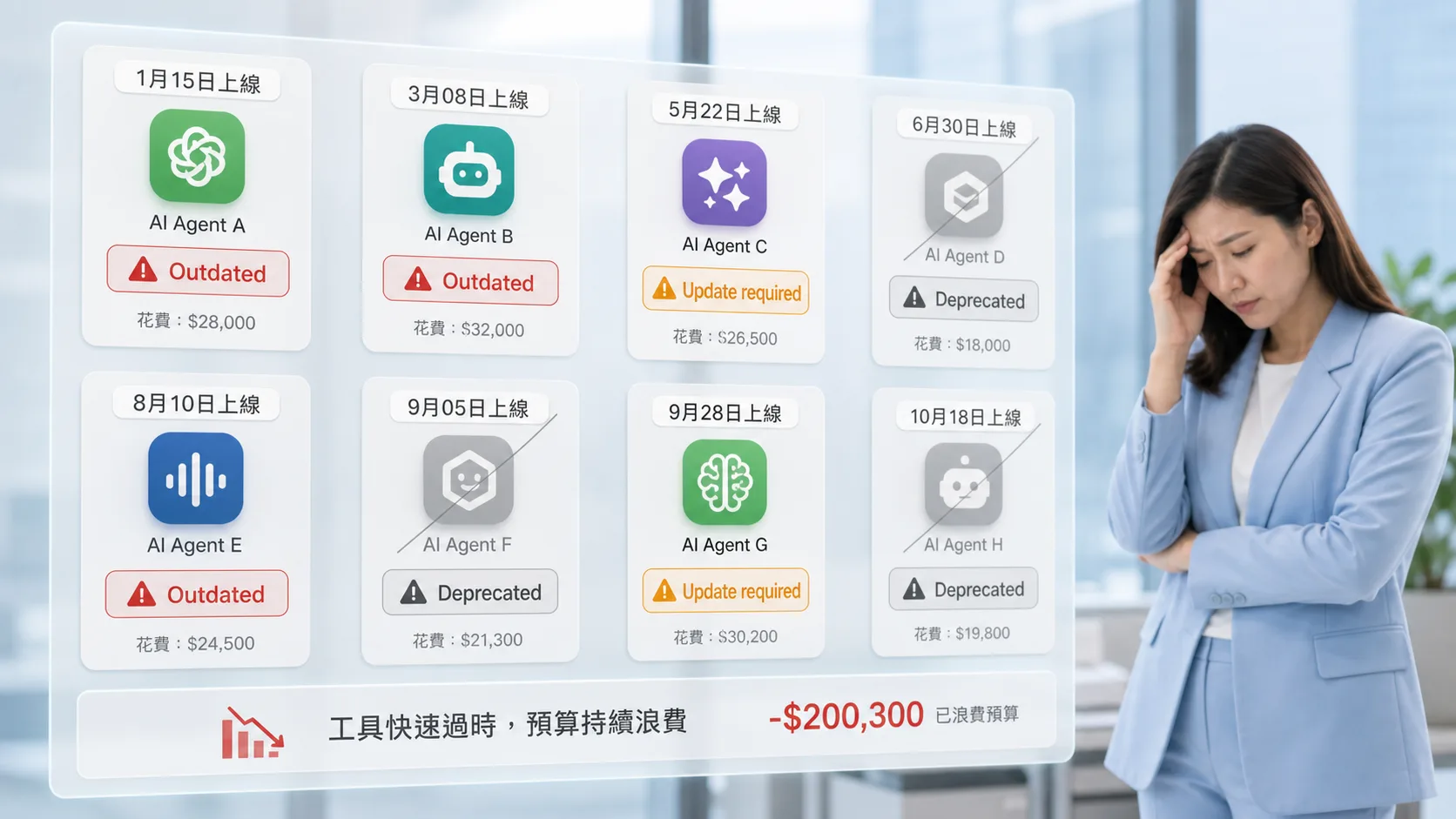
The same thinking applies to AI agents today. AI models will change. Agent tools will change. Interfaces, pricing, platforms, and APIs will change. If a company simply chases the newest tool, it may need to rebuild its workflow a few months later. The better question is: when AI agent tools keep changing, what part of the business operating layer should not change every time?
1. Direct answer: do not lock core workflows inside one AI agent tool
For Hong Kong SMEs, the way to avoid rebuilding workflows every few months is not to chase the most popular AI agent tool. The priority is to build a long-term operating layer around workflow, structured data, permissions with audit records, and human approval.
AI models, AI agent platforms, and automation tools can be replaced. But customer enquiries, quotations, orders, payments, fulfilment, after-sales service, and internal approvals should not be redesigned from scratch every time. When a stronger AI agent appears, clear workflow events, data fields, permission records, and approval rules allow the new agent to plug into the execution layer and improve it. The result is an upgrade path, not a full rebuild of the business process.
In other words, AI agents can change. The operating backbone of the business should not have to change every time.
2. Why do AI agent tools become outdated so quickly?
AI agent development is moving fast. That is a good thing, but it is also why many SME owners hesitate.
The tool that looks impressive today may be overtaken by another model, another agent platform, or another automation product a few months later. Interfaces change. APIs change. Pricing changes. Some tools become more powerful, some get absorbed into larger platforms, and some stop being suitable for your business.
So the real question is not whether there is one AI agent that will never become outdated. That question is probably the wrong starting point.
A more practical question is this: when AI agent tools become stronger, cheaper, faster, and better at executing tasks, can your company benefit directly? Or does every upgrade mean moving data again, redrawing workflows, rewriting permissions, and rebuilding approval logic?
3. The real problem is not tool change. It is when the operating layer follows the tool
Many companies start AI adoption from the tool side. They buy a chatbot, test an agent builder, connect an automation platform, and then build the workflow directly inside that tool.
In the short term, this is the fastest way to create a demo. In the long term, the risk is that the business process becomes shaped by the tool interface.
If the company is still separating the roles of chatbots and AI agents, this comparison may help: What is the difference between an AI agent and a chatbot? The key is to distinguish "answering questions" from "executing workflows".
For example, a company may build enquiry handling, quotation drafting, follow-up reminders, and approval inside one AI agent tool without clearly defining the underlying workflow, data fields, permissions, and approval rules. When a better AI agent appears, the company can theoretically switch tools, but in practice it first has to understand what it built before.
That is the real reason workflows get rebuilt. AI is not simply moving too fast. The company has not separated the relatively stable operating layer from the replaceable execution tool.
When this article talks about "what should not change over ten years", it does not mean workflow, data structure, permissions, and approval rules will literally stay unchanged for ten years. Hong Kong SMEs still need to adjust for payment methods, CRM systems, WhatsApp Business API changes, privacy requirements, platform policies, and customer expectations. The more accurate point is this: these business rules should be more stable than any AI agent tool, model, or platform. They deserve long-term documentation and regular review.
4. First durable layer: workflow
The first layer to preserve is workflow.
Workflow should not be defined by the screen layout of a specific tool. It should be defined by business events. For many Hong Kong SMEs, the core events are fairly stable:
| Business event | What AI can help with | What should not be locked inside the tool |
| Customer enquiry arrives | Classify, summarise, remind the responsible person | Routing rules and ownership |
| Quotation is needed | Draft content, check missing information | Pricing rules, discount authority, approval requirements |
| Customer confirms | Update status, create tasks | Order process, payment requirements, fulfilment commitment |
| Payment is pending | Send reminders, prepare unpaid lists | Payment policy, follow-up rhythm, exception handling |
| Fulfilment is arranged | Organise details, notify internal team | Delivery responsibility, time commitment, customer notification rules |
| After-sales follow-up | Summarise conversation, remind next step | Complaint escalation, refund, recovery decision |
Tools can execute these steps, but the workflow itself should belong to the company, not to one agent platform.
When workflow is defined by business events, a future AI agent only needs to connect to those events and rules. The company does not need to ask again: what exactly should happen after an enquiry comes in?
5. Second durable layer: structured data
The second layer to preserve is structured data.
An AI agent does not work reliably only because the model is smart. It also needs clear, consistent, structured data. Customer information, product details, pricing, orders, conversations, task status, and approval records cannot be scattered across WhatsApp, Excel, email, personal notes, and disconnected tools if the company expects stable automation.
Structured data does not mean making everything complicated. It means the company and the AI can both understand:
- who the customer is
- which workflow status the case is in
- what was discussed last time
- which information is still missing
- who should handle the next step
- which actions require approval
- which records must be traceable later
If the data is structured, the company can benefit more easily when AI agents improve. A newer agent may summarise conversations better, prioritise tasks more accurately, draft replies more naturally, or detect exceptions faster. But it can only do that reliably if it can read consistent and traceable data.
If the data is trapped inside one tool, the first job after a better AI agent appears is not upgrading. It is migration.
6. Third durable layer: permissions and audit records
The third layer to preserve is permissions and audit records.
When people talk about AI agents, they often imagine AI "doing everything automatically". But in real business operations, what AI is allowed to do matters more than how smart it is.
For a deeper look at permission levels, see: How should Hong Kong SMEs set AI agent permissions?
Permission design is not just about restricting AI. It is about allowing AI to enter company workflows safely. At minimum, the company should separate several levels:
| Permission level | What AI can do | Example |
| Read only | Read, summarise, classify | Summarise customer enquiries, organise unfinished tasks |
| Draft | Generate suggestions but not send or execute them | Draft quotation emails, draft WhatsApp replies |
| Submit for approval | Prepare an action for a human to confirm | Submit discount requests, prepare refund suggestions |
| Blocked from automatic execution | High-risk actions must stay with humans | Change pricing, delete records, change access rights, make contractual commitments |
Audit records make these actions traceable. The company needs to know what the AI suggested, what a human changed, who approved it, and what was finally executed.
Permissions and audit records should be treated as one control layer. Permissions without records make incidents hard to investigate. Records without permissions often arrive too late, after the risk has already happened. Together, they allow AI agents to become controlled operating tools instead of convenient black boxes with unclear accountability.
7. Fourth durable layer: human approval and control
The fourth layer to preserve is human approval and control.
AI agents can improve speed, but they should not remove accountability. For Hong Kong SMEs, many decisions involve real customers, real money, and real commitments. Convenience alone is not enough.
These actions should normally keep human approval even when AI becomes more capable:
- money-related decisions such as quotations, discounts, refunds, and payment arrangements
- contracts or service commitments
- customer-sensitive information
- deletion or large-scale update of data
- permission changes
- complaints, disputes, or high-value customer relationships
Human control does not mean every task must slow down. A good design lets AI do the preparation work: organise context, flag risks, draft options, remind the responsible person, and route approval items to the right place.
Humans should focus on judgement and responsibility, not repetitive information gathering.
At the same time, human approval is not automatically safe. If staff are too busy and simply click approve whenever AI recommends something, approval becomes a rubber stamp. Better approval design should show the approver a risk summary, before-and-after changes, amount or sensitive data labels, approval responsibility, and a traceable record.
8. What should a company do when a stronger AI agent appears?
The most important question is not whether AI agents will become outdated. It is whether the company can benefit quickly when a stronger AI agent appears.
If the company already has clear workflow, structured data, permissions with audit records, and human approval rules, a new AI agent does not need to redefine the business. It can replace or strengthen the execution layer.
For example, the enquiry-to-quotation process may stay the same:
- A customer enquiry comes in.
- The system classifies the enquiry type.
- AI summarises the requirement and missing information.
- A salesperson confirms the details.
- AI drafts the quotation or follow-up message.
- If the amount or discount exceeds a rule, the case goes to approval.
- The responsible person approves before anything is sent.
- The system records the whole process.
Today's AI agent may only handle summarising and drafting. Tomorrow's stronger AI agent may understand requirements more accurately, find similar cases faster, highlight risks better, and draft more complete responses.
But if the underlying process and control layer remain clear, the company is not rebuilding the workflow. It is placing a stronger AI capability onto the same business track.
9. How can stable system design help a company absorb AI progress?
The value of stable system design is that it turns AI progress into business capability.
AI usually improves in several directions:
- better understanding of text, images, documents, and conversations
- better classification and prioritisation
- more natural customer communication drafts
- stronger data analysis and exception detection
- better handling of multi-step tasks
- easier connection to tools and systems
If the company's workflow, data, permissions, and approvals are already clear, these improvements can be absorbed more directly. A newer AI agent is not deciding how the business should operate from scratch. It is making the existing process faster, clearer, and less likely to miss important steps.
This is what it means to make the business easier to upgrade with AI progress. The company is not rebuilding the process every time. Because the operating layer is stable, the execution layer can receive more AI capability over time.
However, this is not a guarantee that any AI tool can simply be plugged in and work well. When changing or upgrading AI agents, the company still needs testing, permission review, data protection assessment, and regression checks. Without those foundations, a stronger AI agent may only create confusion faster.
10. What happens when workflow and data are trapped inside a tool?
If everything is trapped inside one AI tool, the setup may feel convenient at first. Over time, several problems appear.
First, the workflow becomes hard to move. The company may not know which steps are tool settings and which steps are real business rules.
Second, the data becomes hard to trace. Customer status, approval records, AI suggestions, and human edits may be scattered across different places.
Third, permissions become hard to control. What AI can read, edit, send, or trigger may depend on scattered settings inside one product rather than company-level governance rules.
Fourth, approvals become hard to investigate. When a customer asks why a promise was made, the company may not be able to trace which AI suggested it, which staff member changed it, and which manager approved it.
In that situation, even if a stronger AI agent appears, the company may not be able to upgrade immediately. It first has to clean up old workflows, move data, rebuild permissions, and repair missing approval records.
It is also important to note that lock-in does not only come from AI agent tools. CRM systems, ERP systems, automation platforms, database design, WhatsApp providers, and low-code workflow tools can also reduce portability. Companies should therefore check whether data can be exported, APIs are stable, workflows are documented, and permissions can be audited.
11. How should Hong Kong SMEs start?
SMEs do not need to turn every workflow into an AI workflow immediately. A more practical approach is to choose one high-value, repeated, and definable process.
Examples include:
- customer enquiry to quotation
- order confirmation to fulfilment
- after-sales enquiry to follow-up
- internal request to approval
- repetitive document handling to task assignment
If the company has not yet chosen the first workflow, start here: How should Hong Kong SMEs start using AI agents without wasting budget?
Then review the process through four operating layers:
| Operating layer | Question to ask |
| Workflow | What are the fixed business events? Who is responsible at each step? |
| Structured data | Which fields must AI and staff read? Where is the data updated? |
| Permissions and audit records | What can AI read, draft, or submit? Which actions need records? |
| Human approval and control | Which situations require approval? Who has authority to approve? |
After these four layers are clear, connecting AI agents usually becomes safer and more useful. The company is not handing undefined chaos to AI. It is allowing AI to work inside a process that already has rules, data, permissions, and approval.
12. oneflash perspective: an AI-ready operating system matters more than chasing the newest tool
oneflash does not see AI agent adoption as chasing every new tool. The more important goal is to help companies build an operating system that both people and AI can use, and that future AI agents can connect to.
In that system, the AI agent is a replaceable and upgradeable execution layer. What stays valuable over time is the company's workflow, structured data, permissions with audit records, and human approval.
This design means today's AI can start by helping with summarisation, classification, drafting, and reminders. When a stronger AI agent appears tomorrow, the company can test and connect more capability under the same operating rules. It is not rebuilding workflows every few months. It is gradually adding stronger AI capability to the business system it already owns.
For Hong Kong SMEs, this is more important than simply buying an AI agent tool. Tools will change. The way a company serves customers, manages data, controls risk, and approves decisions is the part worth investing in for the long term.
13. References
- Harvard Business Review: The Institutional Yes, https://hbr.org/2007/10/the-institutional-yes
- Amazon News: Meet Len Edgerly, Kindle superfan and host of the popular Kindle Chronicles podcast, https://www.aboutamazon.com/news/devices/the-kindle-chronicles-podcast-len-edgerly-interview
- Quote Investigator: What's Not Going To Change in the Next 10 Years?, https://quoteinvestigator.com/2021/03/03/not-change/
- OECD: Empowering SMEs in the age of AI, https://www.oecd.org/en/publications/empowering-smes-in-the-age-of-ai_bf5a9816-en.html
- PCPD: Artificial Intelligence: Model Personal Data Protection Framework, https://www.pcpd.org.hk/english/resources_centre/publications/files/ai_protection_framework.pdf
- NIST: AI Risk Management Framework, https://www.nist.gov/itl/ai-risk-management-framework
- HKPC Academy: Leveraging AI Agents to Optimise Your Business, https://www.hkpcacademy.org/en/10018951-14-leveraging-ai-agents-to-optimise-your-business/
- HKT Enterprise: What is Agentic AI? 5 business use cases, https://www.hkt-enterprise.com/en/blogs/what-is-agentic-ai-5-business-use-cases